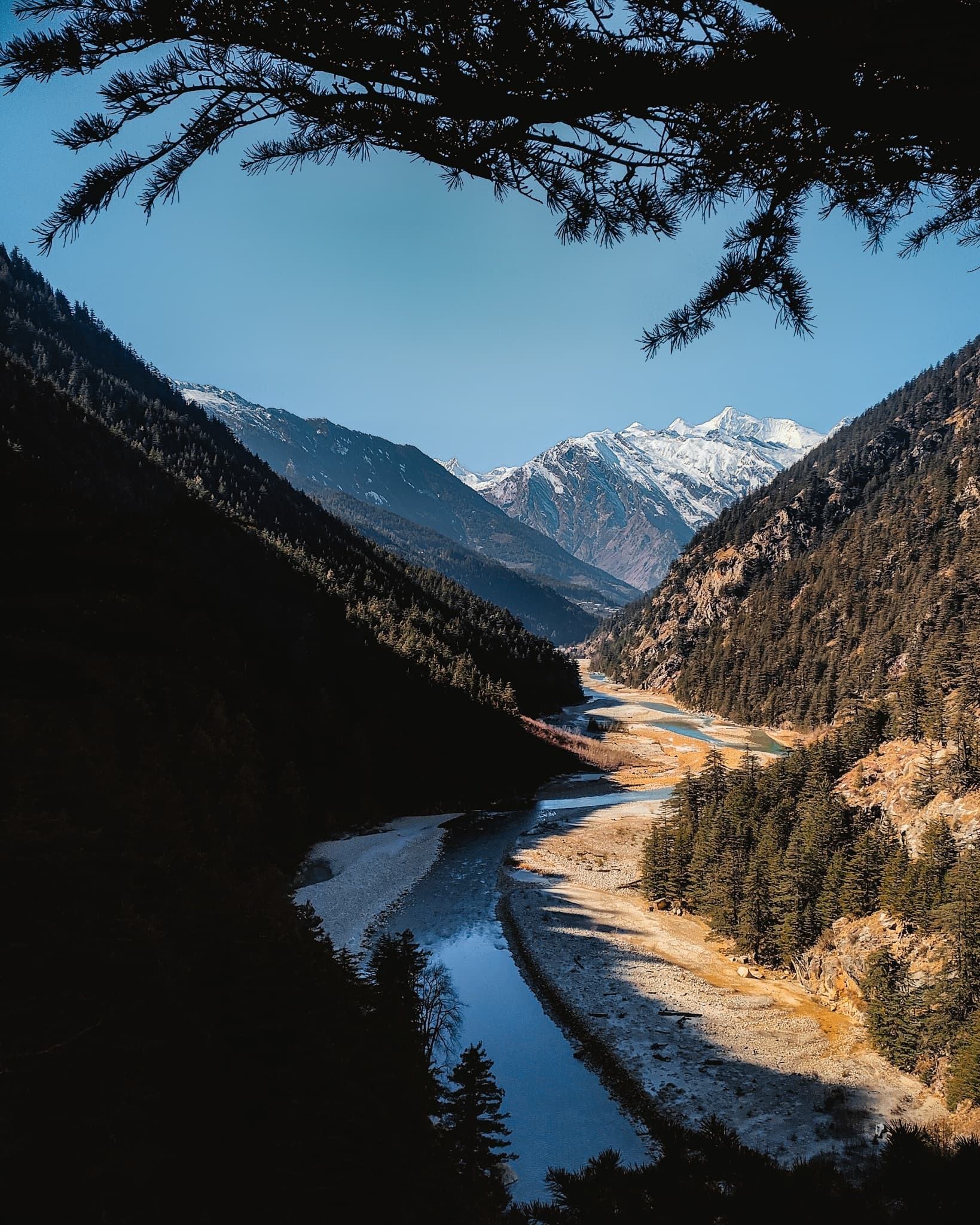
Harshil is Garhwal's best-kept secret — an alpine village at 2,620 m with apple orchards, deodar forests, and views of the Bhagirathi peaks. Combine it with Gangotri's darshan and you have one of the most rewarding journeys in Uttarakhand.
Most visitors to the Gangotri Char Dham drive straight from Uttarkashi to the temple and back in a single day. They miss Harshil entirely. That is a significant oversight — because the village at 2,620 m in the upper Bhagirathi valley is one of the most beautiful places in Garhwal, and its combination of alpine landscape, orchard culture, and Bhagirathi peak views is unlike anything else in Uttarakhand.
What Is Harshil?
Harshil is a small Bhotia village in Uttarkashi district, situated on the west bank of the Bhagirathi river approximately 75 km upstream from Uttarkashi town. The village sits at 2,620 m, surrounded by dense deodar cedar forest and apple orchards. The orchards were first introduced in the 19th century by Frederick Wilson — a British army deserter who settled in the valley and became known as 'Pahadi Wilson', developing a trade network across the Himalayan passes that made him one of the wealthiest men in the region. His apple trees are still there.
The Mountain Views
Harshil sits directly below the Bhagirathi group — Bhagirathi I (6,856 m), Bhagirathi II (6,512 m), and Bhagirathi III (6,454 m) — whose western faces are visible from the village on clear days. This is one of the few places in Garhwal where you can sit in an apple orchard and watch Himalayan peaks of 6,000+ m in the distance. The Shivling peak (6,543 m) and Meru (6,660 m) are also visible from higher points above the village.
Gangotri: The Char Dham Connection
Gangotri at 3,048 m is one of the four Char Dham shrines of Uttarakhand — the others being Badrinath, Kedarnath, and Yamunotri. It is the source of the Bhagirathi river, which joins the Alakananda at Devprayag to form the Ganga. The Gangotri temple, dedicated to Goddess Ganga, is open from Akshaya Tritiya (April–May) to Diwali (October–November). From Harshil, Gangotri is a 25 km drive up the valley — easily done as a day trip.
The Gaumukh Option
Gaumukh — the snout of the Gangotri Glacier at 3,892 m — is a 19 km trek from Gangotri. This is where the Bhagirathi river physically emerges from the glacier ice. The trail follows the river upstream through the Gangotri National Park, passing Chirbasa (3,600 m) before reaching the glacier terminus. The trek is doable in a single long day (5–6 hours each way) for fit walkers, or can be broken with a night at Bhojwasa (3,792 m). Permits for Gangotri National Park are required and are arranged by Himalvara.
The Gangotri Glacier has retreated approximately 22 km since the 19th century and continues to retreat at 22 metres per year. The Gaumukh that Swami Vivekananda visited and the Gaumukh that you will visit are not in the same location. This is not reason to avoid it — it is reason to go now.
Best Time to Visit Harshil and Gangotri
- May–June (pre-monsoon): Gangotri temple opens, apple trees in blossom, clear mountain views; road conditions good
- September–October (post-monsoon): best mountain clarity of the year, apple harvest season in Harshil (September is peak), temples still open until Diwali
- July–August (monsoon): rain and occasional landslides on the Uttarkashi–Gangotri road; Himalvara does not operate this itinerary in monsoon
- November–April: Gangotri temple closed for winter; Harshil accessible but cold and limited facilities
- Absolute best window: late September to mid-October — post-monsoon clarity, apple harvest, temples open
How to Reach Harshil
- From Dehradun: 175 km · 7–8 hours via Mussoorie and Chamba to Uttarkashi, then 75 km to Harshil
- From Delhi: Mussoorie Express or Jan Shatabdi to Dehradun (~5.5 hrs), then road to Harshil
- From Haridwar: 210 km · 8 hours via Rishikesh and Tehri
- Himalvara packages pick up from Dehradun and handle all onward transport
What to Do in Harshil Beyond the Orchard Walk
- Bagori village walk — 2 km from Harshil, traditional Bhotia settlement with Lakshmi Narayan temple and distinctive wooden architecture
- Mukhba village — the winter seat of Goddess Ganga; worth a short visit if the procession is in progress
- Gangnani hot springs — on the Uttarkashi–Harshil road, naturally warm sulphur springs; good for recovery after the Gaumukh trek
- Birding in the deodar forest — Harshil sits in Himalayan monal, koklass pheasant, and Himalayan griffon territory
- Evening at the riverbank — the confluence of the Jalandri stream and Bhagirathi below the village is a quiet spot at dusk
I have brought dozens of groups to Harshil. The ones who stay two nights always say the same thing on the way back: we should have stayed three. Do not treat Harshil as a stopover on the way to Gangotri. Treat it as the destination.
Aryan Gwasikoti
Senior Guide, Garhwal
Aryan Gwasikoti leads Himalvara's Garhwal programmes including the Harshil Valley & Gangotri itinerary. He visits the valley multiple times each season and has stayed with the Wilson family descendants in the village.